Try me!
Examples from EveryLingo's preloaded Dutch library. This is how a bilingual card looks in the app — tap either word to hear it spoken.
🔊 Tap any word to hear how it sounds — don't like it? Overwrite it with your own voice


45 everyday Dutch words from the app, each with audio. Tap a word to hear it. In the app every word also has a picture and plays in all the games.
Cookie. Boss. Yacht. Coleslaw. Landscape. All of them came into English from Dutch, and English speakers use them daily without noticing.
Which is a small illustration of something useful: Dutch and English overlap far more than people expect. *Water* is simply *water*. A child moving between the two finds familiar shapes early, and confidence follows.
The words still have to be heard, repeatedly, to stick. EveryLingo gives you 720+ Dutch words preloaded with audio, in calm repetition games — nothing flashing, nothing engineered to hold attention longer than is good for a toddler. And any word can be recorded in your own voice, or a grandparent's, so your child hears Dutch as your family speaks it.
That is worth doing if your household is Flemish rather than Netherlandic, since the two differ in vocabulary and pronunciation, and a standard recording only ever represents one of them.
Perhaps you are raising your child outside the Netherlands or Belgium. Perhaps your child is a late talker who needs more repetition. Perhaps you simply want to teach them yourself. We are here to help build those first Dutch words.
Every Dutch word plays in simple games that reinforce learning by connecting image, sound and written form. Every word your family edits or makes from scratch is playable in the same games automatically. Tap any game to try it free, no sign-up needed.
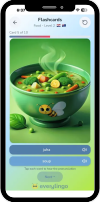
See and hear words in both languages. Tap any image or word to hear it — no flipping required.
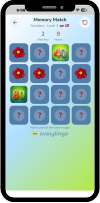
Flip cards and find matching pairs — classic pairs with a bilingual twist.
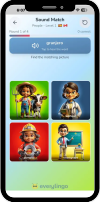
Hear a word, find the matching picture — builds pronunciation and listening skills.
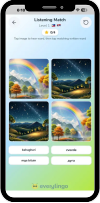
Hear a word, tap the matching picture — in either of your two chosen languages.
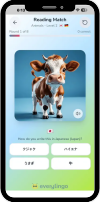
See a picture, choose the right written word — early reading skills in one or more languages.
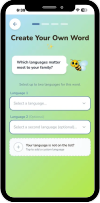
Make your own word cards — your own photo, your own voice, your own accent, in any language.
* Screenshots are a representation of what the app can do in any language, not just Dutch.
Before launch, EveryLingo was shaped by two rounds of research with families around the world.
“I love the fact that you can use your own voice, your own accent when teaching your child a new language. I think it's brilliant and the most unique. I've never seen anything like it.”
“Excellent idea, highly engaging and effective approach to teaching vocabulary while empowering families to preserve their linguistic heritage, particularly for endangered or minority languages.”
“I had the problem growing up of losing the Creole language so I understand this issue.”
“It is a great tool for both kids who are learning to speak and read, and children with special needs.”
“Great tool to help children easily understand and learn their heritage languages.”
“It's the first time I've heard of a language learning app that has a concept like this.”
“I love that it's my voice when teaching the words. So it's still me teaching — my voice is teaching how to speak. I do believe a mother is probably the best at teaching, especially babies.”
“Really interesting and fun, especially in comparison to other language apps like Duolingo.”
“It's going to help me teach my son, and also, I'll learn other languages.”
“Easy tool for my daughter to learn while having fun.”
“The app is very simple and easy to use, which is great for all age ranges.”
“I like the innovative aspect of the application, the fact that it allows multiple languages at the same time. Recording own cards is another great feature that I would use.”
Most families mix a few of these. Here is what each one does well, and what to keep in mind.
Good for: Lovely for sitting close and naming things together, with no screen at all.
Worth knowing: You need to know how each word sounds yourself.
Good for: Rhythm, repetition and lots of voices, which children love.
Worth knowing: Children mostly watch rather than answer, and autoplay can turn five minutes into an hour.
Good for: A real teacher, other children and the culture around Dutch.
Worth knowing: Usually once a week, often from preschool or school age, with travel and fees to plan around.
Good for: Well made for school-age children and adults.
Worth knowing: Most expect a child who can already read, and subscriptions are common.
Good for: Made for ages 0–6: the picture, the sound and the written Dutch word together; games that only need listening, looking and tapping; Dutch on its own or with a second language; and your own voice or dialect on any card. One payment, no subscription.
Worth knowing: It is still a screen, so short, calm sessions work best, alongside books, songs and people.
One to ten in Dutch: een, twee, drie, vier, vijf, zes, zeven, acht, negen, tien. EveryLingo has all ten with audio in the numbers category, so your child can hear each one.
Start with everyday Dutch words your child sees and hears: animals, food, toys, colours and numbers. This page has Dutch words for kids with free audio. EveryLingo's free version needs no sign-up and has no time limit: play the games with a starter set of Dutch words, on its own or with a second language. Full access unlocks all 720+ words for a one-time payment, with no subscription.
Yes. EveryLingo is made for ages 0–6, with Dutch words with pictures and audio, calm games with no timers or ads, and the option to play Dutch together with a second language. You can record words in your own voice or a grandparent's.
Look for four things. Dutch words with pictures, written forms and audio, so children start noticing letter patterns even before they can read, a good base for later. Games that build repetition without pressure: no fast movements, no flashing, no addictive features. Fair pricing, ideally without a subscription. And customisation, because every language has its own nuances, different dialects, and words with cultural meaning that can’t simply be translated. EveryLingo fits all four. Any of its 720+ ready-made Dutch words can be edited (picture, spelling and audio) if it doesn’t fit your needs, and you can make word cards from scratch with your own photos and audio recordings, in your family’s dialect or any language. Your cards play in all the games, in Dutch on its own or with a second language at the same time. It was made by a parent raising a bilingual child, runs in the browser, and has a free version with no sign-up and no card needed. A one-time payment unlocks full access.
Yes. EveryLingo is a vocabulary-building app for children ages 0–6, and it works whether you're raising a bilingual child abroad or teaching a toddler their first Dutch words at home. EveryLingo has 720+ ready-made Dutch words with pictures and audio. The free version needs no sign-up and has no time limit: play the games with a starter set of words in any language or language pair, as often as you like, and make your own word cards too. Full access unlocks all 720+ words and more of your own cards, for a one-time payment of $29.99 USD (lifetime) or $4.99 USD (1 month). No subscription. If the pronunciation, translation or image isn't quite right for your family, you can edit it — or create a new card from scratch. In practice, EveryLingo supports every word you want to pass on to your child.
Start with words your child already sees every day — food, animals, everyday objects, and simple actions. EveryLingo’s preloaded Dutch library is organised into categories like animals, food, objects, nature, colours, numbers, people and verbs, so you can begin with whatever is most familiar to your child. Ten good first Dutch words: hond (dog), kat (cat), melk (milk), banaan (banana), bal (ball), bed (bed), boom (tree), eten (eat), slapen (sleep), omhelzen (hug). You can hear all of them on this page.
Yes — and EveryLingo doesn't assume your child already speaks one language before starting a second or third. A child can connect different sounds — Dutch, English, or any other language — to the very same concept from the start, just as naturally as learning a single word for it. You can pick any two of the 142 language options to play side by side, or add your own dialect in about 30 seconds.
EveryLingo is built for ages 0–6, the early vocabulary-building years. There is no minimum age — babies benefit from hearing words long before they say them, and older preschoolers can use the app to expand their vocabulary. It also depends on your family’s preferences around screens. EveryLingo is deliberately designed not to expose children to flashing, sudden or fast movement on screen — it is calm and unhurried.
No. The preloaded Dutch words already include audio, so your child hears every word even if you are still learning yourself. If you do speak Dutch, you can replace any recording with your own voice.
Yes. You can create your own cards with your own photos or AI-generated images, then record the word in your own voice and accent. This works for regional dialects and family words that no standard Dutch course would include.
Yes. Every Dutch word is a real flashcard with an image, the written word, and audio. The same cards also power all the other games, including Memory Match, Sound Match, Listening Match, Reading Match and Word Blocks.
You can always play the games for free, with a starter set of words from every category and no sign-up required — and you can try creating your own words too To unlock the whole library, along with unlimited editing and custom word creation, EveryLingo is a one-time payment of $29.99 USD for lifetime access, or $4.99 USD for a 1 Month Pass — no subscription, ever. And you don’t only get Dutch: the one payment unlocks all 142 language options, so your family can play in Dutch and any other language alongside it. Every new word, game and language we add is included, at no extra cost.
The Dutch word for "cow" is Koe. EveryLingo includes audio for it, plus a real image card in the animals category.
The Dutch word for "bread" is Brood. EveryLingo includes audio for it, plus a real image card in the food category.
The Dutch word for "fridge" is koelkast. EveryLingo includes audio for it, plus a real image card in the objects category.
The Dutch word for "tree" is Boom. EveryLingo includes audio for it, plus a real image card in the nature category.
The Dutch word for "dark blue" is Donkerblauw. EveryLingo includes audio for it, plus a real image card in the colors category.
The Dutch word for "ten" is Tien. EveryLingo includes audio for it, plus a real image card in the numbers category.
The Dutch word for "dentist" is Tandarts. EveryLingo includes audio for it, plus a real image card in the people category.
The Dutch word for "write" is Schrijven. EveryLingo includes audio for it, plus a real image card in the verbs category.
Play Dutch free